
"This is not the time to be fatigued or to turn away": Interview with Professor Linda-Gail Bekker
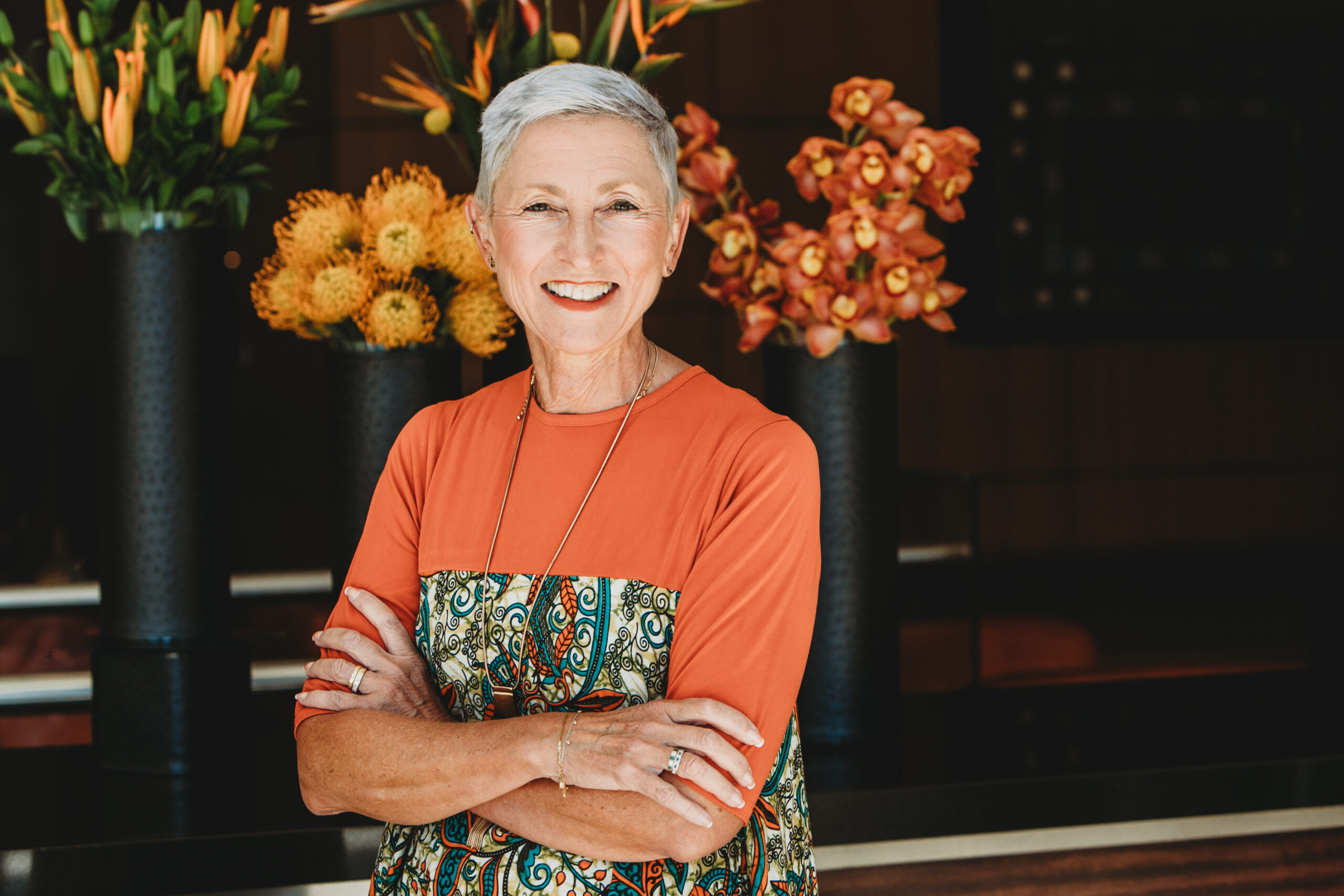
Image credit: Professor Linda-Gail Bekker
Professor Linda-Gail Bekker is a Professor of Medicine and Director of the Desmond Tutu HIV Centre at the University of Cape Town. She is also CEO of the Desmond Tutu HIV Foundation (DTHF).
“LGB,” as everyone calls her, is a remarkable scientist, academic and human. In between her multiple roles and projects (including leading Gilead’s successful Lenacapavir Study, an HIV preventative twice-yearly injection which showed 100% protection against HIV), she makes time to draw and paint. Professor Bekker has a “glass half full” approach and is a firm believer that scientific data must be shared so that it has the potential to benefit everyone. LGB speaks about the current HIV landscape, why HIV vaccines are critical, the importance of collaboration and the exciting work of the BRILLIANT consortium. She gives many words of wisdom for young researchers and given Professor Bekker’s prolific career, her journey will inspire anyone no matter their background.
This is an exciting time for you, the success of Gilead’s Lenacapavir Study, the significant work of the Desmond Tutu Health Foundation and The Desmond Tutu HIV Centre and so much more. Could you speak a little about what’s going on in your career and what you are involved in?
To be honest, I’m 62, so I kind of feel like my career is – with the lens that the glass is half full – that I am at a career summit somehow. I suppose I’ve been quite reflective in thinking what has been achieved and what still needs to be done. I’ve got a lot of thoughts now about ensuring that the Desmond Tutu Health Foundation and the Desmond Tutu HIV Centre are in stable and sustainable spaces. But you’re right, it’s such an exciting time in prevention, particularly antiretroviral-based prevention. I’ve also been looking back on 40 years of the epidemic: What have we done? What do we still need to do? How does the next 40 years look in terms of the global epidemic, but also here in my own world in South Africa and in my own life and career. And then at the same time, enjoying some successes which is just amazing and wonderful. I think the answer is to savour every single moment of success. But, you know, with great joy and success also comes concerning things like how do we make sure we get access? And is everybody going to have equal opportunity to benefit from these things? There is ongoing responsibility to keep the response going which includes ensuring equity and access.
How did your interest in HIV research develop, and what led you to pursue a career in this field?
Well, you’re looking at someone who thought they were going to be a geriatrician. I was absolutely fascinated by P De Vos Meiring’s book when I was at medical school on how to care for old people and I’ve always had a soft spot for old folk. In fact, in my first medical officer job in northern KwaZulu-Natal, the first thing I did was set up a Golden Oldies Club for the oldies. Somebody lent me a house and I used to get all these old guys and old gals around and we used to do OT and chair yoga and a whole lot of other things whilst I was being a busy doctor, obviously not busy enough!
During that time (the late 80s), the HIV epidemic broke in KwaZulu-Natal. We were also right at the end of the terrible KwaZulu wars, so emergency was filled with either people with terrible bullet wounds or people who were dying of AIDS. I was sort of taken aback. I had come through medical school and yet all these people were dying, and I didn’t know how to stop that happening. And with that my career choice changed and I realised I had to go back to university to gain more knowledge. First, I thought I needed to be a better doctor, so I went back to specialise and that led to the specialty of infectious diseases. But then I also realised that I am someone who likes to solve problems, not just narrate about them. And so that got me doing my PhD with the introduction to the exciting world of research and discovery. The rest is history.
The only infectious diseases that have needed full attention throughout this time have been HIV and TB, just because of the sheer volume and extent of the disaster. But I remain fascinated by any kind of pathogen and I have the capacity to remember the names of the oldest organisms and I have no idea why! I am fascinated by pathogens and how we as humans are in constant battle with pathogens.
South Africa has had a traumatic and inspiring HIV history, from AIDS denialism to remarkable activism which catalysed the introduction of ARVs, to emerging as a global leader in HIV clinical trials and a hub for HIV research. What is the current HIV landscape in South Africa? Is HIV still a serious health threat?
It undoubtedly is! It’s even more of a threat in some ways in that although the denialism was troubling, without doubt, it was harrowing, but it organised us into a united, solidified mission which was to overcome this epidemic, to find the best care and to optimise the care by ‘come hell or high water’ kind of approach. We now still have the biggest epidemic in the world. We still have the largest number of people who need antiretrovirals. We still have almost 2 million people we haven’t found and linked to care. And we still have over 1000 young women who become infected with HIV every week. Much remains very urgent, but what we don’t have now is that sense of urgency. We don’t have that sense of activism and the notion that we all must continue to join hands in the battle. Those pictures of us in the TAC (Treatment Action Campaign) marches where we literally had clasped our arms, that sense is gone. That real sense of mission. My concern is how we will either find that again and probably won’t, so what will sustain us to keep this fight going?
We now still have the biggest epidemic in the world. We still have the largest number of people who need antiretrovirals. We still have almost 2 million people we haven’t found and linked to care. And we still have over 1000 young women who become infected with HIV every week. Much remains very urgent, but what we don’t have now is that sense of urgency. We don’t have that sense of activism and the notion that we all must continue to join hands in the battle.
It certainly has evaporated in the rest of the world. At least in the developed world, the epidemic has reached some sort of plateau – unless you’re sitting in central Russia or Eastern Europe or in the MENA regions where we do still see HIV going up, which is very disturbing. Here, we still have a last mile to navigate, and I really worry about our sense of energy and determination to walk that last mile. And here I think it’s important that somehow we engage young people, funders, stakeholders and government that the last mile is going to need more resources. It’s going to need more innovation. It’s going to need more creativity. This is not the time to be fatigued or to turn away or to think it’s done. This is a time when we really do need to roll up the sleeves and – cliché as it is – we must get back to work. How we really get that message across is the challenge of our time. In South Africa, maybe because needs must, we have stayed the course better than many, but I fear that other priorities, other epidemics, other needs come in and quickly detract, quickly take our attention elsewhere and sadly take the resources elsewhere.
I think it’s also an important time to say, “What can HIV teach other areas of medicine and public health here in this country and beyond?” Because there is no doubt, it’s been an inspiring as well as difficult 40 years. The inspiration has been around how we have differentiated care, how we have task shifted and task shared, how we have been so incredibly creative. And those nuggets really should be shared with other areas of health and medicine.
Understanding the social has been a huge part of the work that you do. Why is it crucial to consider the social context when conducting HIV research and developing treatments, and how does this understanding inform your work?
My thinking is framed by the following: HIV happens to human beings and human beings are social creatures that have behaviours. Even the simple act of taking a pill is a human behaviour. Showing up for a vaccination is a human behaviour. Tolerating an injection and coming back again for that injection is a human behaviour. And human behaviour is very much impacted by the social context – all that is going on in that individual’s life. I think we absolutely fool ourselves if we think it is simply about making a pill that’s better than the last pill or designing a vaginal ring that’s going to have more than one application. Sure, it’s critical that we do that and having those tools in the toolbox is great, but if you don’t have someone who’s willing to open the toolbox, take out the tools, apply the tools, make sure that the tools fit into their lives and they can use it, then it won’t be of any benefit.
I think as much as I am a biomedical specialist and I really believe we are where we are because of the terrific creation of an antiretroviral agent 30 years ago – and I hold great promise that we will find a vaccine that is affordable and durable and effective – none of this is of any use if we don’t actually apply the innovation to the lives of the people who we deal with.
Now HIV, as we’ve all recognised over many years, is a non-discerning virus. It goes for whatever human, shape and form it can attack. Too often, those individuals are dealing with many social ills in social contexts that perhaps contribute to their being more at risk or more vulnerable or in a position where they are exposed to the virus. Maybe not, as I say it’s not discerning, it goes where it goes. But it is important that we understand those individuals’ lives and their social context if we want to try and apply the biomedical tools we have today most effectively. It is with that in mind that this biomedical professional has had to be very humble and realise that yes, we started with A, B, C which was abstain (all about behaviour) and we’ve come full circle, and we can’t leave that part of it behind. I am delighted that we can apply tools today, but at our folly if we think we can do that without understanding the behaviour and the social science that goes with it.
Can you discuss your involvement in the BRILLIANT Consortium and the importance of BRILLIANT? Is there still a need for an HIV vaccine?
Let me start with “Is there still a need for an HIV vaccine?” because I feel very strongly about this even though I am a great believer in – and I have spent three decades understanding – ARV-based prevention. ARV-based prevention is terrific and needed and we must deploy it, and we must exploit it, but it will not eliminate HIV. The reason I say that is by the very nature of antiretroviral-based prevention, you’re not going to deploy that generically and universally to large tracks of people. You’re always going to need to know serostatus which immediately raises a whole lot of stigmatising issues. You’re always going to need people to come back because, by the nature of it, it’s a pharmaceutical and it is metabolised, and works its way out of the body and then needs replenishment. Whether it’s daily, weekly, monthly or six-monthly, it’s got to be replenished. That immediately puts some limitations on its use. There are some people who are just not good at coming back, there are others who never want to show up in the first place. There are others who don’t want to be tested for good reason.
ARV-based prevention is terrific and needed and we must deploy it, and we must exploit it, but it will not eliminate HIV.
So, can we ever get to the place where we have an immune-based preventive vaccine which can be deployed to large groups of people maybe even before, long before, sexual debut? Before there’s any risk of HIV acquisition? We’re all very familiar with this – we go for our anti-tetanus, or we have our BCG when we’re born. We’re very familiar with the notion of vaccines and they are very normal in our everyday lives. They’re not linked to sex or being “other” or being promiscuous or having early sex or whatever might be holding back people from accessing prevention today. Being able to deploy a vaccine to large tracks of people across the world is how we will eliminate this virus because that’s what we did for smallpox, and what is being done for Polio and other infections we are making headway on.
To use the analogy of the bush fire, which is a well-known one: if there is little kindling around and little flickers of fire, you constantly have to survey, you constantly have to know that this fire can re-ignite at any time if there’s wind or you take your eye off that area. In the meantime, while we seek the vaccine, we must apply primary prevention at scale, with good universal treatment and get the epidemic absolutely under control, but we will never be able to stop watching unless we have a vaccine deployed.
I feel very strongly that an HIV vaccine is the pinnacle of prevention. And how exciting to be part of the research and discovery right here on this continent, where the need is great. I am a firm believer in the innovation, the creativity and the capacity that exists in our continent. And the belief that we have been exporting great research findings and information North for three or four decades, and we can make the same contribution with HIV vaccine science. I think it is a wonderful opportunity in my career. There is one word that describes it, it’s “brilliant.” It’s absolutely brilliant. We chose that word because we must have said it 50 times when we were devising the concept document to bid for this consortium. And it really is, it’s just frankly brilliant! It gives us the chance to show what we can do. It helps us set the agenda as we believe it is. We can truly look for the vaccine that is going to be relevant to Africa and to our needs. And it validates us. We can show the world we can do this efficiently, effectively, cost-effectively and we can do it brilliantly. It’s another gift in my career that I feel very privileged to experience, that I get a chance to do this, because – well frankly – it’s brilliant!!
What do you see as the future of HIV research in South Africa, and what exciting developments can we expect to see?
The future is our past as well. South Africa in particular, but Africa at large, has made huge contributions to both treatment and prevention innovation, R&D (Research & Development). Often maybe not in the laboratory (and this is again where BRILLIANT is great because it takes us right through the whole pipeline). Often it hasn’t been right at the R (Research) phase – the lab application – but certainly we’ve played a very important role in the development of these innovations and then the iterative component of showing how best to apply innovation at scale. Given the large numbers of people in our region who end up using those innovations, we are sending back research material to say, “Well this is what we learned in the implementation” or “Here are the drawbacks” or “Here’s how you can improve it” or “This is what else can be done.” This applies to HIV, TB and malaria.
Our role must be recognised in the history books going forward. This is important to say. We were there during COVID-19 and I believe we will continue to play a developmental role. We are unfortunately the continent with the greatest burden, but also excellent expertise certainly in the clinical research arena. I have no doubt we will continue to punch way above our weight in that regard. We can do more of the research side – the actual making the innovation and contributing really throughout the pipeline. That applies to both HIV and TB. I think some of the work we’re doing now in understanding the aerobiology of tuberculosis to my mind is world-class. And again, you can argue it makes sense that we’re doing it because this is where the epidemic is greatest. But at the same time, we don’t have all the research resources that others have. But, I was struck some years ago when Elsevier – the journal group – looked to see how many papers had been written in HIV and TB, and South Africa features. It’s America, the UK and then here’s South Africa. We have made amazing contributions, and I suspect we will continue to do so, and I certainly hope we do.
Historically, what have been the roles of South African scientists in HIV clinical trials and what new opportunities and roles does BRILLIANT afford our scientists?
The place we’ve really made our mark without doubt has been in late stages of clinical development. So, the big efficacy trials. Also, I think we’re very good at doing community engagement and really understanding our communities and positioning our research as a partnership with communities. Maybe that’s also because our TB and HIV epidemics are so real, and so communities are deeply affected at many levels.
I honestly believe this is a true partnership between communities. We’ve been able to bring science into communities and communities into our science. I think that has really set us apart in ways that probably is quite unprecedented in any area of research or medicine. I think we’ve done that extraordinarily well. I think we’ve also been incredible advocates both for the research as well as for optimising care and treatment and prevention. We know what we need, and we’re not frightened to ask. We also have some of the best, most ardent and expert advocates who also play a critical role in all of this.
I honestly believe this is a true partnership between communities. We’ve been able to bring science into communities and communities into our science. I think that has really set us apart in ways that probably is quite unprecedented in any area of research or medicine.
I think increasingly, we begin to show that we can play a significant role on the innovation side as well, in the discovery science. And it’s not to say we haven’t made contributions there. Certainly, in virology and pathogenesis we have. I suspect that will just go from strength to strength particularly when we start to see resources flow in this area. A lot of this is driven by resources and I think perhaps as we see resources being localised and coming more directly to us, I think we’ll begin to see capacity develop. It will become more mainstream for us to make contributions at every level and I’m looking forward to that. I think we are up for it, and I think we will show up well.
You were recently ranked the “Best Female Scientist in South Africa” for 2024 based on your H-index of 111. What does this achievement mean to you?
Well, it validates the fact that I am very promiscuous in my interests, and I write papers on a broad range of topics! And again, incredibly lucky to have amazing collaborators all over the world who also write papers. This is always teamwork. I don’t think there’s a single paper where I am the single author – unlike how molecular research was in the past where you’d be an individual at the bench working away at a single molecule. I have huge respect for those individuals, but I count myself lucky that my work is often in teams and collaborations, and I’ve just been so lucky to work in so many areas that have felt relevant and useful.
My passion is to make sure that the data gets out so that other people can benefit. I am a bit of a tyrant with my team that if they do research and get data, the data needs to be turned into a paper. I am on their case all the time for that. But it is also quite addictive to see data that you have collected and interpreted get peer reviewed and published. For those young researchers who might read this, once you publish once or twice you get bitten by the bug. I really encourage young scientists to not only collect data, but ensure it is written up and disseminated to the world and also back to the participants and communities who partnered with you to do the research.
We have a responsibility to generate good information and then make sure that that good information is in a sharable peer-reviewed form. That’s how science grows and that’s how knowledge grows. There’s no doubt in our field it is iterative, it is progressive. We too rarely have those occasions like the Lenacapavir 1 which is mind-blowing. Most of the time, we need to be grateful and excited about the little wins, the incremental steps forward. Even if the step forward is a step backwards. Even if the information is ‘No that doesn’t work’ or ‘In this population that isn’t going to be the right way forward.’ Glenda Gray and I – in the HIV vaccine field – we’ve had a lot of those. In many ways, a little bit like when you stub your toe too often you can be tempted to say, “well I won’t ever run again,” but what you have to say is “I’m going to put on stronger boots, I’m going to pick my feet up more and I’m going to run as much if not further.” And she’s been a great partner in crime in that regard. We’ve faced quite a lot of disappointments, but I’m excited about BRILLIANT. I think we’re going to learn a lot, and we are already learning a lot just about what South Africa is capable of, what Africa is capable of, what can be achieved. And then hopefully, you never know, we’ll find a vaccine which we’ll export North!
My passion is to make sure that the data gets out so that other people can benefit…We have a responsibility to generate good information and then make sure that that good information is in a sharable peer-reviewed form. That’s how science grows and that’s how knowledge grows.
Looking back on your career, what are some of the most memorable moments or projects that have had a lasting impact on you?
There have been so many, I have been so lucky. On my career, I think the Lenacapavir moment was a wonderful, career-defining moment. That was humbling and extraordinary and I felt so lucky to be the spokesperson for an amazing trial. It was beautifully executed and a tribute to the whole protocol team, and all 5000 participants.
I think it’s also been the smaller studies we’ve done locally where communities have really come in and been part of it. The early antiretroviral dissemination studies where people demonstrated the Lazarus effect, and young people’s lives were literally saved. I’ve been so lucky to be part of those sort of moments where young people have been staring at their grave and then thanks to taking some antiretroviral tablets, they’ve not only been saved, but they’ve gone back to work, back to teaching, back to being productive mothers, fathers, members of society. It has been such an extraordinary privilege to see that kind of feedback for work that has been done. I think those are the life-changing, career-defining moments. There are many of them and I am grateful for them all. Contributing to individuals’ lives being changed and communities being held together has been a wonderful, wonderful privilege in my life and I’m immensely grateful.
Based on your experiences, what advice would you give to young researchers who are interested in pursuing a career in clinical research?
Be bold and go for it! If you have a curiosity, if you have energy – because it is hard work – but you also have that sense that you want to change the world and make a difference, then clinical research is an excellent career in which to do it. You do need to “gird your loins” because it is hard work and there are many steps forward and quite often a few steps backwards. But at the same time, I cannot think of a more rewarding career. So, if this is something you feel might be for you then I would just push you in that direction.
Network, network, network! Get out there and get to know other people. Find a good mentor, or three if it comes to that! People who have the generosity to promote you, to advise you, to hold your hand through the tough times. But very quickly, find your niche and stick with it. Publish! And ask for help. Grant writing, getting funding, isn’t easy and you don’t get born with that attribute. Even ask people to share successful grants with you so you can read how others have done it. Again, I would just say get out there and talk to people, get networked and enjoy the ride. It’s extraordinary. And as I say, there isn’t a single thing that I would change in my career. And I realise that I am really privileged to be able to say that, and very grateful.
Read our related articles:
Interview with Professor Glenda Gray on the BRILLIANT Consortium
Towards an HIV-Free Future: BioInformatiCo Partners with the BRILLIANT Consortium