Our Leova Synthetic Data Generator placed second of 19 submissions in Use Case 1. We'll be presenting it in Denver on 5 October.
The CDISC AI Innovation Challenge
CDISC is the global clinical data standards body; the FDA and Japan’s PMDA mandate its standards for regulatory submissions. Now in its second year, its AI Innovation Challenge asks member organisations to showcase solutions that use AI and machine learning to automate more of the clinical data lifecycle, with CDISC standards as the backbone.
This year’s challenge received 50 submissions from 30 organisations and individual entrants across three use cases. Expert judges scored each submission, weighting standards integration and traceability most heavily. The winner and runner-up in each use case are invited to present at the CDISC US Interchange.
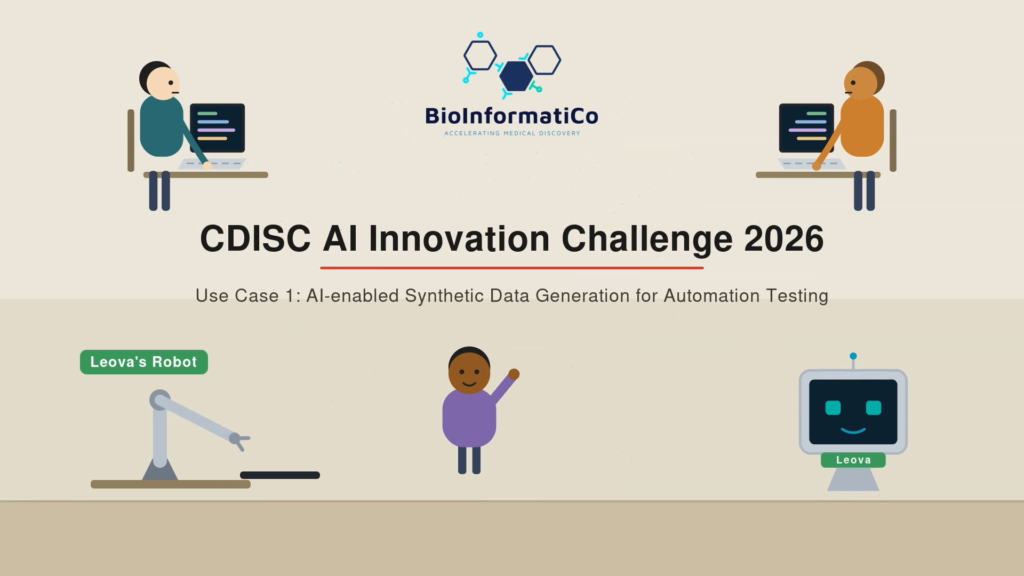
We entered Use Case 1: AI-enabled synthetic data generation for automation testing. We submitted a vision of Leova, the platform we are building to deliver our own studies, and a demonstration of how it works.
Why we built Leova
Before a clinical trial can enrol its first participant, someone has to build the database behind it: the forms that collect the data, and the checks that are meant to catch mistakes as they are entered. A build error may only surface months later, in a live study, where every fix is costly change control.
Leova starts from the protocol, the source of truth for a study database build. It turns it into USDM, CDISC’s machine-readable model of a study, and derives the build from that single model: the forms and fields, the edit checks that police them, and the mappings into SDTM. Because they all come from the same place, they can be checked against each other.
The only reliable way to confirm an edit check functions correctly is to present it with data it should reject.
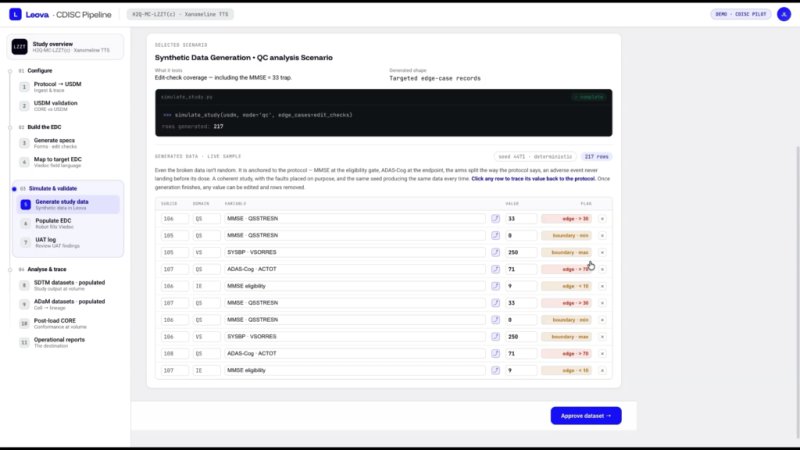
The only reliable way to confirm an edit check functions correctly is to present it with data it should reject. Leova generates synthetic participants, including ones designed to break the rules on purpose. A robot enters them into the database (Viedoc, in our case) exactly as a person would, so we can see which edit checks fire and which let bad data through.
In our demonstration we planted a mistake: the robot entered a score of 33 on a scale that stops at 30, and the database accepted it, because that upper-bound check had never made it into the delivered build. This is user acceptance testing, automated. Each missing check it exposes gets corrected before the study goes live. The synthetic data then carries on through the rest of the chain, into SDTM and ADaM datasets. CORE, CDISC’s own conformance checker, then tests those against the standards.
Traceability carried the most weight in the judging, and this is where it shows. When a regulator asks where a number in an analysis dataset came from, the answer should be readily available. Leova keeps that chain from the protocol through CDASH, SDTM and ADaM, so a gap found at data entry can be followed back to the design decision behind it and forward to the analysis it would have reached. The whole run is repeatable, so when the protocol changes the tests go again rather than being rebuilt by hand.
What the judges said
The judges called it “a distinctive closed-loop testing approach”, meaning the test runs from the protocol all the way to the analysis and reports back. They singled out the deliberate use of problematic scenarios to verify fault detection, and the connection between study design, data collection and downstream analysis. They placed Leova second of 19 submissions in Use Case 1.
Why it’s important
Why does this matter to us? Because we do the data management on these studies ourselves, not just the software. Our work includes first-in-human HIV, Ebola and TB vaccine trials across Africa, where a build error found six months into a live study costs time nobody has. Leova exists because we’d rather find those errors before the first participant is enrolled.
Recognition from CDISC carries weight, because it comes from the people who write the standards we build to every day.
Shirley Collie and Robert Kieser will present Leova at the 2026 CDISC US Interchange in Denver on 5 October.
If you would like to understand how we could support your next study build, get in touch and we will walk you through it.